
Celebrating 50 Years of York Mystery Plays

The Last Judgement
Fifty years ago, a bold experiment brought medieval drama back to life – and it all started here at Leeds.
When the International Medieval Congress (IMC), delegates can look forward to a lively programme of performances and exhibitions celebrating drama, music and storytelling from the Middle Ages.
Among the highlights will be an open-air production by the Lords of Misrule, continuing a tradition of medieval theatre revivals that began with a pioneering 1975 staging of the York Mystery Plays.
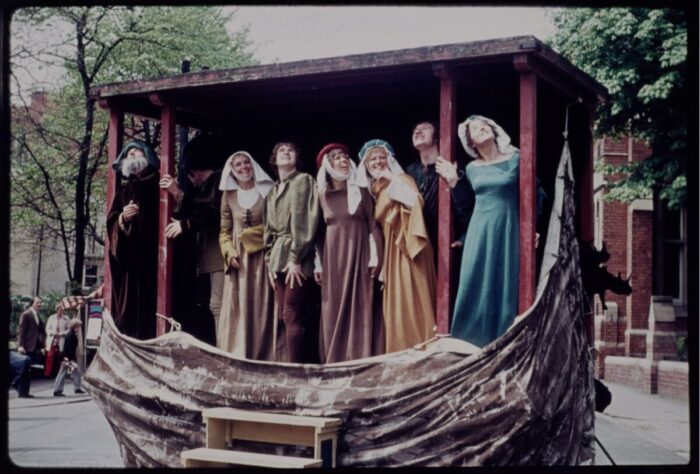
Noah and his family on the ark.
The 'Leeds Experiment'
As part of the University’s Centenary Celebrations in 1975, a group of medieval drama specialists – led by postgraduate student Jane Oakshott – proposed a bold idea: to stage the first full-scale, pageant wagon production of the York Mystery Plays since 1569.
The York Mystery Plays are a cycle of late-medieval biblical dramas originally performed by York’s guilds on wagons moving through the streets. Each guild staged a play linked to their craft – for example, the shipwrights performed ‘The Building of the Ark’ and the bakers took ‘The Last Supper’.
Senior Congress Officer Marta Cobb explained: “You can almost see these plays as a sort of commercial promoting the work of the guild.”
These plays were banned after the Reformation, when laws forbade the portrayal of God onstage. Inspired by the scholarship and teaching of medievalists at Leeds, Jane saw the University’s Centenary as the perfect occasion to recreate this collaborative spectacle.
Supported by the Graduate Centre for Medieval Studies – the precursor to today’s Institute for Medieval Studies – and a £300 grant from the Centenary Committee, she recruited volunteers from across the University and local drama groups.
Marta added: “Jane’s aim was to show that surviving medieval records provide a blueprint for a practical and effective mode of performance on pageant wagons, even centuries later.”

Soldiers discuss how best to perform the crucifixion of Christ.
Recreating the medieval city
In medieval York, pageant wagons travelled through the city streets, stopping at designated locations to perform scenes from biblical history – from Creation to Judgement Day. The 1975 Leeds production embraced that processional spirit.
University departments were matched with plays related to their academic focus: Physics staged ‘The Creation’, Earth Sciences performed ‘The Creation of the World’ and Civil Engineering took on the challenging ‘Crucifixion’ – a play intended to depict the Crucifixion convincingly, without actually hurting anyone!
Finding suitable wooden wagons was a major challenge. Eventually, eight were tracked down, re-dressed between scenes and used to carry 36 plays across two days.
On 17 and 18 May 1975, the University campus transformed into a medieval street theatre. Lining the procession route was a market with stalls selling refreshments and other items, such as papal indulgences or lead charms ‘guaranteed’ to turn into gold.
Marta said: “In addition to University staff and students, members of local drama groups were involved too – a real ‘town and gown’ affair! The plays and fair involved about 500 actors and more than 280 helpers from the University and city, with more than 4,000 people coming onto campus to watch the performances.”

The Medieval Market
Lasting legacy
The 1975 production not only revived a centuries-old performance tradition but also sparked a renaissance of processional medieval drama in cities across the UK and beyond. Later performances followed in Wakefield and Toronto, and in 1994, Jane herself directed the first fully processional York Mystery Plays in York since 1569.
It all started in Leeds, with a determined group of medievalists and a belief that scholarship and performance could go hand in hand.
That tradition thrives at IMC 2025, where delegates can not only attend performances but also explore their history through drop-in sessions in the Treasures Gallery. Organised by the University’s Special Collections, these sessions feature original archive materials from the 1975 production.