
IMC 2027 Call for Papers - 'Communities'
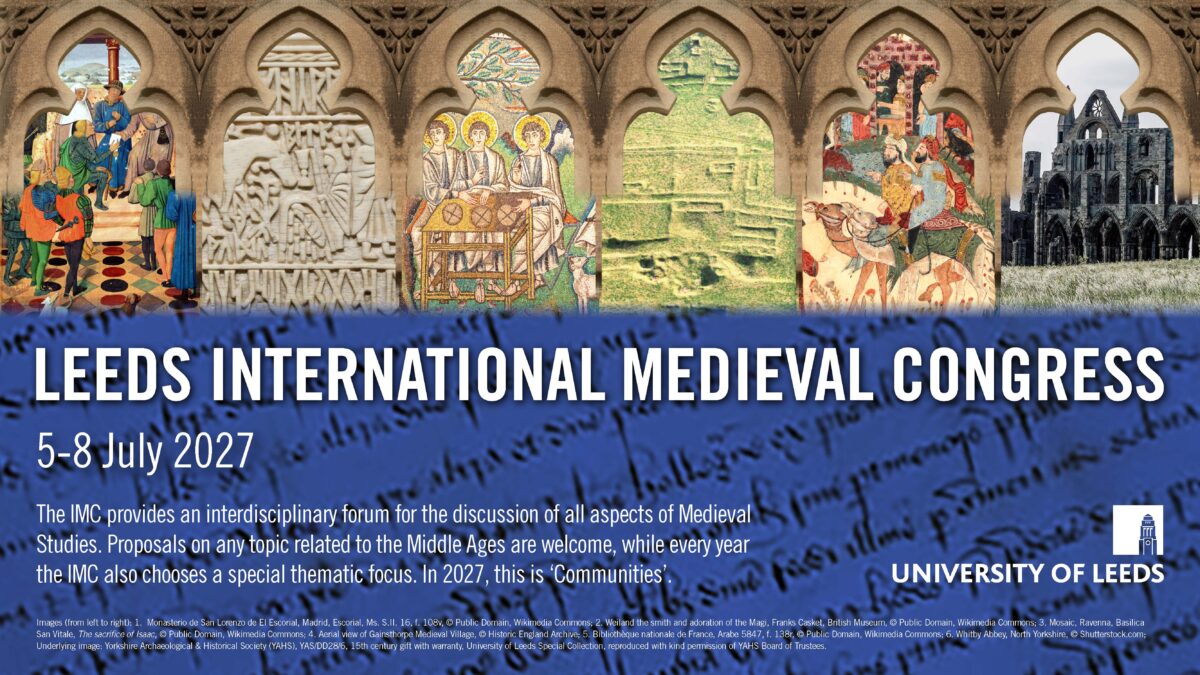
IMC 2027 will take place from Monday 05 July to Thursday 08 July 2027 and this will be the sixth fully-hybrid event. There will be an in-person gathering in Leeds with a virtual component for those unable to attend in person.
Call for Papers: IMC 2027 - Communities
The IMC provides an interdisciplinary forum for the discussion of all aspects of Medieval Studies. While proposals on any topic related to the Middle Ages are welcome, every year the IMC chooses a special thematic focus. In 2027, this will be ‘Communities’.
The study of communities involves groups of people, their sharedness, and how those groups define themselves and manage challenges over time. They include the individual’s experience, place, and change relative to the group. The relationship between the individual and circle of social actors with whom they interact affects how these groups appear and work as well as how they influence the actions and activities of the individual.
Communities can form across ethnic, linguistic, social, political, professional, spatial, and religious identities. Often these identities intersect, with individuals often belonging to multiple communities, which could bring advantages or cause conflict and hostility. But how are these groups defined today, and how do we use different methodologies to analyse communities, including multidisciplinary perspectives? Approaches such as the consideration of imagined, embodied, or emotional communities, as well as the concept of ‘communities of practice’, open up a wider range of research disciplines and areas. Other research questions address how communities emerged and were maintained, their value and legitimacy, the use of memory to consolidate collective identities, how to achieve cohesion, or how different communities impinged on each other.
Key topics across different fields include, but are not limited to:
- Political, religious, confessional, and ethnic communities
- Structures, hierarchies, rules, regulations, administration, and law
- Emotional, imagined, textual, and discourse communities
- Material culture of communities
- Symbols and identifiers
- Language, multilingualism, language learning, and linguistic markers of communities
- Communities of knowledge and practice
- Community of/with God(s)
- Spaces and places, rural and urban, daily life, and living communally
- Travelling and migrating communities
- Commemoration and origins myths, legacies, and the lost and forgotten
- Projection and performance of communal identity
- Chant, song, liturgy, and ritual
- Being part of a community (inclusion/exclusion), legitimacy, values, and cohesion
- Within/without - ‘them’ and ‘us’ - exile, outlawry, expulsion, and closed and marginal-ised communities
- Neighbourliness
- Sense of community and sense of belonging
- Decline and collapse, loss of purpose/focus, and external eradication
- Traditional and innovative communities
- Scholarly and disciplinary communities, medieval and modern
- Communities of violence and disruptive communities
- Non-human communities and non-human social actors
The IMC welcomes session and paper proposals submitted in all major languages.
IMC 2027 is the global medieval platform which promotes a broad spectrum of perspectives and critical discussions on medieval studies. We aim to engage scholars working at all geographical scales, from global to local contexts, and across various time periods. The IMC especially welcomes papers that bring in perspectives from under-represented disciplines, regions, and theoretical and conceptual perspectives, in all major languages.
The Special Thematic Strand ‘Communities’ will be co-ordinated by Cosmin Popa-Gorjanu (Departamentul de Istorie, Arheologie şi Patrimoniu, Universitatea ‘1 Decembrie 1918’ din Alba Iulia).
Find Calls for Papers
Check out our IMC 2027 Padlet, which will be updated with Calls for Papers for IMC sessions or round tables as they are released on social media.
If you are a session organiser and would like your call for papers to be added to the IMC 2027 CfP Padlet, please email [email protected].
How to Submit
Don't forget to read our Participation and Acceptance Criteria before submitting your paper or session proposal.
Paper proposal deadline: 31 August 2026
Session proposal deadline: 30 September 2026
Format: As in previous years, we are planning to host a fully hybrid conference with the option for in-person or virtual participation.
You will be asked when submitting your proposal about whether you would prefer to present your paper or session in person or virtually. It is important that you let us know your preference, as this information will inform our planning of both virtual and in-person elements.