
IMC 2026 Interview: Emma Dillon
IMC 2026 is just around the corner, and the administrative team are very busy preparing for the most important week of our year. We would, however, like to take a moment to share and celebrate those who make valuable contributions to the congress. The IMC would not be the incredible, immersive experience that it is without the contributions and efforts of every delegate, bookseller, artist, craftsperson, performer, workshop director, and excursions guide at the conference.
In this interview feature for IMC 2026, we had a conversation with Emma Dillon (Department of Music, King's College London), who is the Principal investigator of the Musical Lives project.
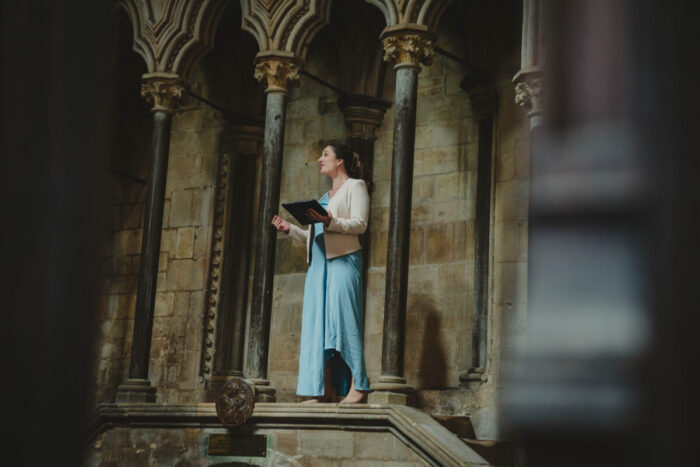
The singer Rebekah Nießer-Jones from MUSLIVE/Siglo de Oro. Photo credit: Will Coates-Gibson
What can you tell us about MUSLIVE?
"MUSLIVE is a 5-year interdisciplinary collaboration, Musical Lives: Towards an Historical Anthropology of French Song, 1100-1300, funded by a UKRI Frontier Grant, hosted in the Music Department at King’s College London. It was successfully evaluated by the ERC Advanced Grant scheme, and, as that scheme encourages, it offers opportunities to work in ways rare in our field. Namely, it supports scholars and performers of different expertise for sustained engagement, individually and collaboratively, with questions of common concern that are not easily answered by any one field alone. MUSLIVE offers alternative ways into the fundamental questions: What is a musical life? What would a history of people and human experience, orientated around practices of songs, poetry, and performance, look and sound like? It takes up those questions through a case study of French song (trouvère song), using archival and musical evidence to follow songs, song-makers, their families and connections throughout Europe and the Mediterranean. In this way, MUSLIVE reorientates existing western Europe-focused histories of song and retells the social history of the Middle Ages through the prism of the essential role played by music and singing."
"The project comprises a core team of myself (musicologist), three postdoctoral research fellows, Alice Hicklin (history and charters), Betty Rosen (medieval Arabic and Hebrew poetry), and Geneviève Young (medieval French and Occitan literatures), as well as our project research assistant, Fiona Barsoum, herself a medieval French scholar. We also have a large network of regular collaborators, including our project advisors, and our amici, asdiqā’, and compaignons (including the Trouvère Translation Collective and Song Collective). From the outset, we have also collaborated regularly with members of the vocal ensemble Siglo de Oro, directed by Patrick Allies (also our project’s musical advisor) and more recently with a theatre-maker, Constance des Marais."
You can read more about the project on their website: https://muslive.kcl.ac.uk
What have you learned from working with the ensemble Siglo de Oro?
"Our collaborations bring a Siglo singer together with a scholar of literature and a scholar of music (our project compaignons) to form a ‘song team’. Initially, their work involves a slow exploration of song texts in practice, exploring every dimension of what, collectively, we can know or deduce from the written sources of songs, especially as they pertain to sound. It’s a revealing process when undertaken collaboratively, about what the texts might mean at a word-by-word level, about how the melody ‘reads’ text, and reflection about what’s not notated or written. In this setting, Siglo’s singers often raise questions regarding the characterisation implied by a text and its motivation more generally, or the mood and meaning of a particular word, as well as pragmatic questions of where to pitch a song or the speed at which to deliver it. Personally, returning often to such questions has slowly changed my relationship to the repertory, to reckon more directly with the obvious: they were created to live in time through performance."
"Our singers take a final, bold step of assimilating what has been revealed in discussion and then making their own choices about how to set a song for performance. In that stage of the process, I’m always struck by how each song stands out as being distinctly different from another, with its own character and emotional atmosphere. I’ve also learned a lot from MUSLIVE’s postdoctoral research fellows, Alice, Betty, and Geneviève, who have taken questions of performance and practice into textual traditions one might not immediately think of as musical – in poetry, epic, and charters, for example. They’ve also been encouraging others to this active way of thinking with texts in their recent co-taught MA course ‘Listening to the Archive’."
What can delegates expect from the ‘Build a Song Workshop’?
"This is a chance to ‘see under the bonnet’ of the MUSLIVE-Siglo way of working with songs, in this case from the medieval French repertory (trouvère song), in a fun, informal, and interactive setting. Guided by Siglo singers Paul Bentley-Angell, Hannah Ely, Rebekah Nießer-Jones, and their director, Patrick Allies, along with MUSLIVE scholars, we’ll take delegates through the process of working with a song from scratch – from manuscript right through to a performance. It’s very much the chance for participants to try things themselves, to ask questions, and contribute their own ideas and suggestions. So there’ll be ample time to experiment with translations, transcriptions, to ponder pronunciation, plus to explore how the singers deal with questions of character, voice, and feeling when they make the songs their own ahead of a performance."
"We’ll also share how, in the project, we’re using the same approach to develop performance-led approaches to other texts, including those without musical notation, and so to think about how the approach could transfer to areas of interest among the delegates. We’ll be working with two songs from the ‘Time for Songs!’ concert, so delegates will also get to hear the songs performed in full in the concert on Wednesday 8th July. Above all, we want delegates to experience the fun of working together in a group where no one person has all the answers but where collectively everyone has something useful or interesting to share and where, at the end of it, we get to hear how things work in practice. No prior expertise in music or Old French required!"
Why should delegates attend the 'A Time for Songs!' concert?
"Everyone involved in creating ‘A Time for Songs!’ would agree that the performances by Siglo’s singers are at the heart of the show. So delegates can, above all, expect to be thrilled by the powerful and deeply committed performances Siglo’s singers, Hannah, Paul, and Rebekah have developed. For those unfamiliar with the medieval French repertory (trouvère song), it’s the chance to hear a rich sample of that tradition – from big love songs, to lighter narrative genres, and a few surprises thrown in. We’ve selected songs which are rarely performed, so for afficionados, we hope it will be the chance to hear areas of the tradition that are less familiar."
"Delegates will also hear songs woven into recitation from textual traditions contemporary with trouvère songs, attuning to them as one thread in a sonic tapestry from across the Mediterranean. Finally, they should expect a performance that is a little different from a regular concert, which invites the audience to engage in a different way, too. So the MUSLIVE-Siglo collaboration creates short narrative framing to the songs, presented by the MUSLIVE team. The programme thus tells a story, taking inspiration from the songs and texts in the show and from the project’s research discoveries about the medieval people and communities once associated with them."
For this concert, we’ve taken inspiration from the IMC theme, so the programme loosely reflects songs’ interest in time – the pasts and futures they conjure and so on. We’ll also be working with a brilliant theatre-maker, Constance des Marais, who helps the ensemble with staging of our performances, to offer audiences as immersive and engaged an experience of the songs as possible. Finally, we love sharing more about the work behind the scenes, so audiences can anticipate a parting memento programme with more information about the songs and MUSLIVE project and also the chance to chat with the project team and singers. If you leave humming a song, then our work is done!"
Do you have a favourite song from the performance?
"I love all the songs equally and know that the audience will too!"
What are the challenges in adapting medieval music for a modern audience?
"For song traditions, language can sometimes be a challenge. In trouvère song, we’re dealing with highly crafted poetry in medieval French – we obviously can’t go back in time to hear and understand as 12th-century audiences did. Modern audiences vary. Some don’t listen for meaning. Some want to know what singers are singing about, line-by-line. There’s no rule. Even with excellent and accessible translations, it can be hard for audiences to follow along in the real-time of performance."
"When it’s so word-dense, following with the programme in hand during a performance can risk disengaging audiences from the performer. It changes the experience. Obviously this is not a question limited to medieval music! But working with and without translations in real-time, or with different styles of translation, or experimenting with other ways to communicate to audiences about the meaning of a song, is itself a really productive way into the issue."
How do you hope IMC Delegates will respond to the performance?
"I hope they will appreciate the commitment and feeling of our singers, who bring so much to each song. I hope they wi
ll enjoy the narrative framing as an experiment in telling stories about and with songs, and also enabling programme-free engagement with the songs."
How did you first learn about the IMC?
"As a graduate student, around the time of the first IMC meeting in 1994."
How many IMCs have you attended?
"I’ve slightly lost track – but around 7 or 8."
What is your favourite thing about the IMC?
"As lovely as attending the papers and events is, bumping into old friends and colleagues on the way to and from sessions and catching up around the edges of the busy schedule."
What do you wish you had known before your first IMC?
"My first IMC was also my first large-scale conference. So my advice to my younger self would be to study the programme and campus map well in advance and to pack a pair of comfortable shoes!"
What is your favourite IMC memory?
"One of my early IMCs was when I was a Lecturer at Bristol University, where I taught in the Music Department and was also a member of the Centre for Medieval Studies from 1998-2000. The Centre sponsored sessions at IMC, and I have very fond memories of being there as part of the Bristol medievalist delegation."
Most surprising thing you’ve learnt at the IMC?
"I think it was at IMC that I first saw a falconry demonstration. It’s one thing to read about them but quite another to encounter our feathered friends up close!"
How has the IMC helped you?
"The IMC offers so many wonderful opportunities – to learn, to share work, to be inspired, and to connect with so many interesting people. There is also a magic ingredient of community that makes IMC so special. It’s such a supportive and encouraging conference. It’s helped me in so many ways. Maybe most importantly is that it’s always served as a huge inspiration and tonic, especially hearing new directions in the field, so I always leave fired up (if ready for a rest!)."
Describe the IMC in 3 words
"Inspiring. Magnificent. Collegial."

Emma Dillon