
IMC 2027 Interview: Special Thematic Strand Coordinator Cosmin Popa-Gorjanu
In October we enjoyed a visit from Cosmin Popa-Gorjanu, the Special Thematic Strand Coordinator for IMC 2027. During his stay, Cosmin helped the team with organising the thematic strands, creating a preliminary schedule draft for the programme, and reviewing session and paper submissions. While he was with us, we sat down to ask him a few questions a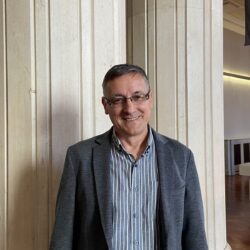 bout his experience with the IMC.
How did you first learn about the IMC?
I first learned of the IMC while a student in the Department of Medieval Studies at Central European University in Budapest. In 2003, I travelled to Leeds by bus to give a paper. I remember having many new experiences, like attending a session on medieval drama. I recall a popular keynote on the Carolingians that was standing-room only.
How many IMCs have you attended?
Three previous IMCs in 2003, 2017, and 2018. Next year will be my fourth.
Which IMC Special Thematic Strand was most inspiring to you?
To be honest, I haven’t paid much attention to them, which I think is actually a good thing. The Special Thematic Strands can help to inspire the direction of your work if you want it to, but it does not demand that you halt your current research in order to fit with it. I think it is a good idea to offer a Special Thematic Strand because it enables scholars from different subjects to examine their fields from a similar viewpoint and work together.
What does ‘Community’ mean to you for the IMC?
Community is a subject with great promise. It offers us the opportunity to ask ourselves how people organised themselves to face challenges collectively. It is a very complex concept to tackle historically. So often we tend to focus on consequential individuals, which is not a wrong approach, but somehow these individuals and their actions or thoughts tend to push aside the rest of the multitudes. It is a challenging subject because it makes us think about communities of different sorts and from different perspectives.
What is your most vivid IMC memory?
I met so many medievalists here, some of whom I knew from before but others I met for the first time. In attending in 2017 and 2018, these meetings with colleagues developed into major research plans. Those exchanges of ideas with colleagues and friends stand out to me.
What would you recommend to those attending their first IMC?
Come without any hesitations or fear. You should not feel intimidated. I send my own MA and PhD students to the IMC and tell them to be at ease. They get to put their thoughts and presentations in front of an audience which will provide feedback and encouragement. At my first IMC someone I didn’t know approached me afterwards to shake my hand and congratulate me. At the IMC you can learn, and get energy, inspiration, and friends.
What is your favourite thing about the IMC?
Meeting the people. The people are the most important part of the IMC. Here we find people with whom we can talk, from whom we can learn, and with whom we can exchange ideas. The opportunity to meet people in your field and related fields is here, it’s at the IMC.
What was the most memorable interaction you’ve had at the IMC?
There are plenty to choose because I attended sessions and exchanged ideas with so many friends and other scholars. One that sticks out was with the late Paul Hyams of the University of Oxford, who I had first met in Budapest at CEU. When we met again at Leeds, he suggested we sit together to meditate on some Shakespearean verses. He had such interesting ideas. His approach to social relations was inspiring to my own work.
Most surprising thing you’ve learnt at the IMC?
I think it has been my time as coordinator of the Special Thematic Strand. In reading the abstracts for the papers and nearly 600 sessions in the Special Thematic Strand, I became more aware of the richness and diversity of Medieval Studies. I was already aware of new developments in the discipline, but now I had the opportunity to look much more closely at the research questions in areas different to my own. The challenge of approaching scholarship from another point of view was a great surprise. Related to this is the surprise of the geographical expansion of papers and speakers at the IMC from what I can remember from 2003.
Describe the IMC in 3 words.
Excellence, collegiality, opportunity.