
IMC 2026
Conference Programme
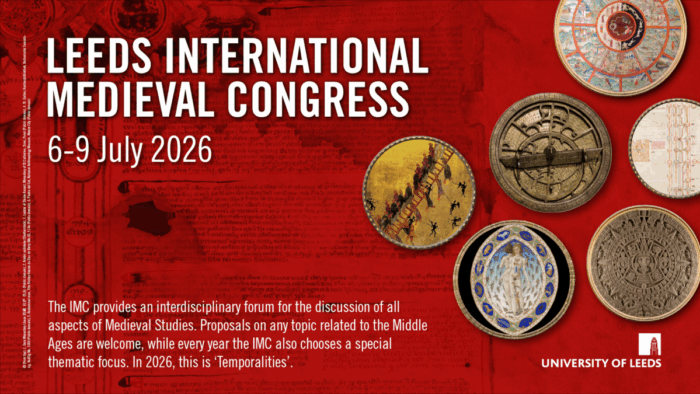
In 2026 the special thematic focus of IMC was ‘Temporalities’.
- Browse by timeslot
- Browse by sessions
- Browse by keywords
- Browse by strands
- Browse by sponsors
- Browse by participants
The IMC Programme Book contains details of all academic sessions, the Bookfair, as well as all events, excursions, workshops, and other IMC activities alongside essential information about attending IMC 2026 both online and in-person.
To view and download the PDF Programme, please use the button below.
View and download the IMC 2026 Programme [PDF]. (pdf), File DownloadAccessible Programme
You can find a plaintext, screenreader-friendly version of the IMC Programme introductory pages here.
Please get in touch by emailing [email protected] if you have any queries, or would like to request an accessible version of the IMC 2025 Programme in an alternative format.
About the Conference
Temporality, commonly understood as the study of time, how people perceived it, and its impact on the human experience of life, is a rich and multifaceted concept that spans many disciplines, including philosophy, history, literature, sociology, psychology, archaeology, art history, music, and science. While earlier studies often treated time as an ‘object’, today’s medieval scholarship increasingly explores temporalities - the many ways in which time is intertwined with human existence and agency. This approach seeks to understand how medieval people perceived, structured, and interacted with time, considering their past, present, and future perspectives.
The relationship between medieval people and time was dynamic, evolving over epochs and involving diverse manifestations and outlooks. It also influenced contemporary perceptions of the medieval period, as well as modern identities and memories of the past. This makes temporality a pivotal feature of medieval cultures spread across the entire medieval globe and a universal theme of study in the world that succeeded the Middle Ages.
The most common way of studying medieval temporalities is by focussing on medieval people’s views and experience of time. How they viewed their past, present, and future was deeply influenced by religious beliefs and exegetical interpretations of the ‘world’s beginnings’, eternity, and end. Along with these shared understandings, everyday lives were shaped by nature and its seasonal changes. Their livelihoods often depended on aligning their daily activities with the natural rhythms of time, interpreted by calendars or more advanced ways of measuring time. Diverse notions of the passage of time affected medieval people’s political decisions, economic exchanges, and production of objects and artefacts. Medieval people manipulated time to reflect their gender roles, narrative strategies, views on human ageing, shifts in ethnic or social groups, or changes in public and private spaces.
Modern concepts of medieval time are bound up with our own understanding and (ab)use of medieval temporalities. Whether we construct images of a ‘Dark Age’, or imagine a romantic time of chivalry and knighthood, these projections into the past reflect our own temporal outlooks and how today we organise ‘medieval time’ in a variety of ways that address modern diverse political or cultural agendas, which lie at the heart of our debate on medievalism.
By examining the temporalities of the medieval world, together with our present-day perspectives on the spectrum of the medieval past, present, and future, the Congress aims to encourage a lively debate by international scholars about medieval people’s relation with time and the impact of this relation on our present-day agencies, mentalities, and global experiences of life.
Key topics across different fields that shed light on the relationship between time and medieval people include, but are not limited to:
- Medieval perceptions of time, temporality, and their modern interpretations
- Concepts of time and temporality in medieval philosophy and theology
- People in time
- Time as an agent of change
- Temporality in political, economic, and socio-cultural relations
- Calculation and estimation of time and dating
- Time measurement by using calendars, sundials, and clocks
- Timing and scheduling meetings and events
- Narratives of time and the language of temporality
- Documentation of time
- Time, memory, and commemoration
- Scholarship, technological development, and temporality
- Temporal materialities
- Time, nature, and the environment
- Methodological approaches to the study of medieval temporalities
- Medieval temporalities in film, media, digital technology, and Artificial Intelligence
- Artistic representations of time and temporality
- Medieval temporalities in literature, music, performing arts, and folklore
- Temporality in law, medical practice, education, and music
- Medievalism and medieval temporalities
- The future of the Middle Ages