
IMC 2026
Conference Programme
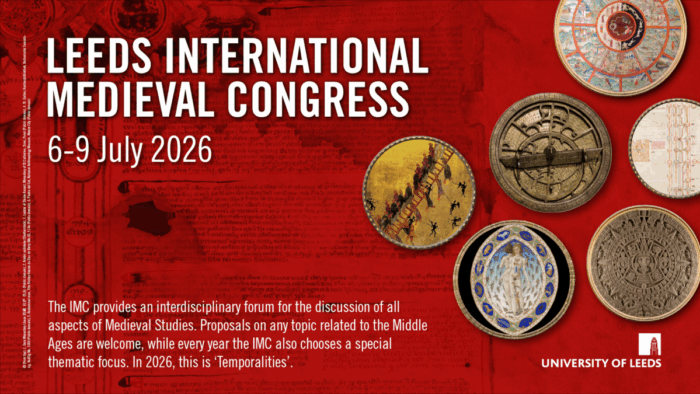
In 2026 the special thematic focus of IMC was ‘Temporalities’.
- Browse by timeslot
- Browse by sessions
- Browse by keywords
- Browse by strands
- Browse by sponsors
- Browse by participants
The IMC Programme Book contains details of all academic sessions, the Bookfair, as well as all events, excursions, workshops, and other IMC activities alongside essential information about attending IMC 2026 both online and in-person.
To view and download the PDF Programme, please use the button below.
View and download the IMC 2026 Programme [PDF]. (pdf), File DownloadAccessible Programme
You can find a plaintext, screenreader-friendly version of the IMC Programme introductory pages here.
Please get in touch by emailing [email protected] if you have any queries, or would like to request an accessible version of the IMC 2025 Programme in an alternative format.
About the Conference
Temporality, commonly understood as the study of time, how people perceived it, and its impact on the human experience of life, is a rich and multifaceted concept that spans many disciplines, including philosophy, history, literature, sociology, psychology, archaeology, art history, music, and science. While earlier studies often treated time as an ‘object’, today’s medieval scholarship increasingly explores temporalities - the many ways in which time is intertwined with human existence and agency. This approach seeks to understand how medieval people perceived, structured, and interacted with time, considering their past, present, and future perspectives.
The relationship between medieval people and time was dynamic, evolving over epochs and involving diverse manifestations and outlooks. It also influenced contemporary perceptions of the medieval period, as well as modern identities and memories of the past. This makes temporality a pivotal feature of medieval cultures spread across the entire medieval globe and a universal theme of study in the world that succeeded the Middle Ages.
The most common way of studying medieval temporalities is by focussing on medieval people’s views and experience of time. How they viewed their past, present, and future was deeply influenced by religious beliefs and exegetical interpretations of the ‘world’s beginnings’, eternity, and end. Along with these shared understandings, everyday lives were shaped by nature and its seasonal changes. Their livelihoods often depended on aligning their daily activities with the natural rhythms of time, interpreted by calendars or more advanced ways of measuring time. Diverse notions of the passage of time affected medieval people’s political decisions, economic exchanges, and production of objects and artefacts. Medieval people manipulated time to reflect their gender roles, narrative strategies, views on human ageing, shifts in ethnic or social groups, or changes in public and private spaces.
Modern concepts of medieval time are bound up with our own understanding and (ab)use of medieval temporalities. Whether we construct images of a ‘Dark Age’, or imagine a romantic time of chivalry and knighthood, these projections into the past reflect our own temporal outlooks and how today we organise ‘medieval time’ in a variety of ways that address modern diverse political or cultural agendas, which lie at the heart of our debate on medievalism.
By examining the temporalities of the medieval world, together with our present-day perspectives on the spectrum of the medieval past, present, and future, the Congress aims to encourage a lively debate by international scholars about medieval people’s relation with time and the impact of this relation on our present-day agencies, mentalities, and global experiences of life.
Key topics across different fields that shed light on the relationship between time and medieval people include, but are not limited to:
- Medieval perceptions of time, temporality, and their modern interpretations
- Concepts of time and temporality in medieval philosophy and theology
- People in time
- Time as an agent of change
- Temporality in political, economic, and socio-cultural relations
- Calculation and estimation of time and dating
- Time measurement by using calendars, sundials, and clocks
- Timing and scheduling meetings and events
- Narratives of time and the language of temporality
- Documentation of time
- Time, memory, and commemoration
- Scholarship, technological development, and temporality
- Temporal materialities
- Time, nature, and the environment
- Methodological approaches to the study of medieval temporalities
- Medieval temporalities in film, media, digital technology, and Artificial Intelligence
- Artistic representations of time and temporality
- Medieval temporalities in literature, music, performing arts, and folklore
- Temporality in law, medical practice, education, and music
- Medievalism and medieval temporalities
- The future of the Middle Ages
IMC 2025

Conference Programme
In 2025 the special thematic focus of IMC was 'Worlds of Learning'.
- Browse by timeslot
- Browse by sessions
- Browse by keywords
- Browse by strands
- Browse by sponsors
- Browse by participants
The IMC Programme Book contains details of all academic sessions, the Bookfair, as well as all events, excursions, workshops, and other IMC activities alongside essential information about attending IMC 2025 both online and in-person.
To view and download the PDF Programme, please use the button below.
View and download the IMC 2025 Programme [PDF]. (pdf), File DownloadAlternatively you can access and browse the online interactive programme here.
Accessible Programme
You can find a plaintext, screenreader-friendly version of the IMC Programme introductory pages here.
Please get in touch by emailing [email protected] if you have any queries, or would like to request an accessible version of the IMC 2025 Programme in an alternative format.
About the conference
Histories of learning have transformed fundamentally over the last generation: older research mainly investigated educational institutions or specific intellectual traditions, typically privileging forms of learning which could be connected to modern Western institutions and disciplines. More recent scholarship takes a broader approach, historicising the production and circulation of different forms of knowledge, including many non-Western cultural traditions, as well as practical knowledge, oral traditions, and types of technical or artisanal expertise not represented in the modern canon. As a result, new interdisciplinary research fields have broadened the thematic and geographical scopes of investigation and developed new comparative frameworks.
Perhaps most importantly, different cultural traditions and historiographies of learning across the globe are increasingly discussed in relation to each other or on the basis of interdisciplinary exchange on methodologies. The increasingly global scope of academic exchange enables us to think more productively towards connected histories of learning, whether global or regional in scope, and including non-elite and non-traditional forms of learning.
Processes of learning and resulting written traditions have also been re-situated in their social and material contexts, deepening our understanding of the cultural embeddedness of knowledge. Various recent approaches question the meaning of institutional descriptors like ‘schools’ and challenge the dividing lines between ‘scholarly’/’expert’ or ‘elite’ and ‘popular’ cultures. Frameworks discussing ‘communities of learning’, ‘communities of interpretation’, or ‘communities of practice’ highlight the role of exchange and conflict between different communities and social strata in the production of knowledge. They also allow for a much broader integration of different forms of practice, performance, and oral communication into the study of intellectual production.
On a methodological plane, our understanding of the use, distribution, and long-term differentiation of specific bodies of knowledge profits greatly from a greater appreciation of their mediality and materiality, with new approaches to genre, communicative uses, and the circulation of manuscripts and printed books, but also to a variety of images, objects, and (architectural) landscapes. A growing toolkit of digital approaches has proved to be both a boon and a challenge, as the gathering, analysis, and visualisation of relevant data promises innovative new insights, but also raises questions about standardisation and access to costly infrastructures.
Against this background, IMC 2025 invited a plurality of viewpoints investigating the manifold social, intellectual, and geographical ‘worlds of learning’ shaping pre-modern societies. Seeking to stabilise the trend of the previous years, the strand particularly encouraged sessions focusing on non-European worlds of learning. It also invited sessions which address the challenges inherent in the highly diverse disciplinary landscape and the asymmetries shaping extant historiographies of learning, which come from both different global regions and separate disciplines with different emphases.
The Special Thematic Strand 'Worlds of Learning' was co-ordinated by Sita Steckel (Historisches Seminar, Goethe-Universität Frankfurt).
IMC 2024
Conference Programme
- Browse by timeslot
- Browse by sessions
- Browse by keywords
- Browse by strands
- Browse by sponsors
- Browse by participants
The IMC Programme Book contains details of all academic sessions, the Bookfair, as well as all events, excursions, workshops, and other IMC activities alongside essential information about attending IMC 2024 both online and in-person.
- Click here to view the interactive programme on Confex.
- Click here to download the PDF Programme
- Click here to download a plain text, screenreader-friendly version of the IMC Programme introductory pages
Accessible Programme
Please get in touch by emailing [email protected] if you have any queries, or would like to request an accessible version of the IMC 2024 Programme in an alternative format.
Call for Papers: IMC 2024 - Crisis
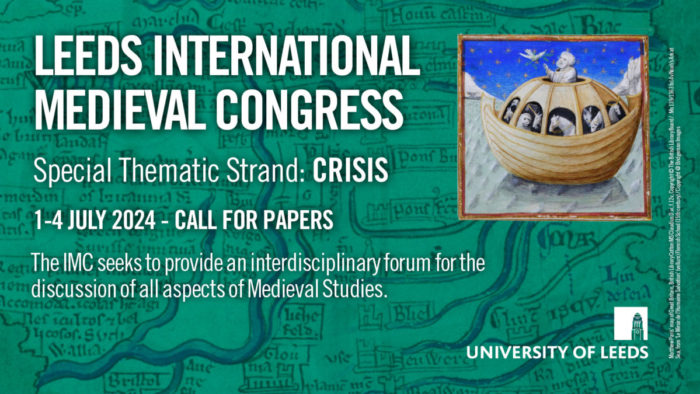
The IMC provides an interdisciplinary forum for the discussion of all aspects of Medieval Studies. Proposals on any topic related to the Middle Ages are welcome, while every year the IMC also chooses a special thematic focus. In 2024 this is ‘Crisis’.
‘Crisis’ has long been used when writing about the Middle Ages – incorporating climate and environmental issues such as epidemics, famines, and floods, political issues such as the breakdowns of dynasties and popular revolts, and socio-cultural issues such as religious apocalypticism and the questioning of faith. Yet while crisis is a concept deep-rooted in a wide range of scholarship, it has also recently been reconsidered. Rather than seeing whole periods as characterized by crisis conditions, medievalists now explicitly ask ‘crisis for whom?’ Medieval institutions and systems could be resilient, surviving challenges and pressures. Yet people simultaneously suffered hardships, even if not everyone suffered to an equal degree. Medievalists are also interested in how individuals and communities coped with crisis. Indeed, medieval societies had their own perception and understanding of risk and found ways to adapt. An important component of this was the construction of crisis narratives, sometimes informed by religious beliefs – stories that changed across time, place, and audience. Temporality is also fundamental to medievalists’ understanding of crisis, offering important counter-perspectives to views of linear progress and modernization paradigms often seen in crisis historiography. While substantial crises could serve as short-term ruptures and turning points, crises also provoked more incremental changes within economies, institutions, and cultures over time. Some things stayed the same despite crises and, thus, continuity remains important.
A new language of resilience, vulnerability, and adaptation has become prominent within medieval studies in recent years: stimulating new kinds of questions and new approaches to old issues, as well as allowing medievalists to engage with other disciplines. However, to what extent are these old ideas just repackaged with new terms? How we can define, measure, and test these concepts?
IMC 2024 invites a plurality of viewpoints and critical engagement with these concepts. We hope to engage scholars working at a variety of geographical scales – from the global to the micro-community, and over a variety of timescales – from those linking the Middle Ages to Antiquity or the early modern period to those focusing on an individual year. The proportion of IMC sessions focused outside Europe continues to grow – a trend we hope to see again in 2024. We welcome approaches from across medieval studies, including economic, political, social, cultural, demographic, linguistic, artistic and visual, religious-historical and intellectual, environmental, as well as those relating to landscape and material culture, and approaches that engage those working outside the disciplines of medieval studies per se, integrating relevant evidence from genetics, bio-archaeology, historical climatology, and much more!
Themes to be addressed may include, but are not limited to:
- Critical discussion of relevant terminology – crisis, collapse, adaptation, risk, resilience, transformation, vulnerability – and pathways forward
- The creation of crisis narratives and stories
- Who is to blame during crises? Scapegoating, hate, compassion, and cohesion
- Medieval crisis-related datasets, their application, pitfalls, and uses
- Inequalities, and the unequal impacts of crises
- Explicitly gendered approaches to crises
- Entangled scales, global pressures/hazards played out at local or micro levels
- Early modern and modern representations of medieval crisis
- The interaction of religious and institutional responses to hazards
- Intersectional considerations in responses to crises
- Demographic approaches to hazards and disasters: deaths, births, marriages
- Material culture and conceptualizing crisis – objects and rituals
- Hazards, shocks, disasters, and their redistributive impact
- Textual representations of crisis and its impact on human agents – trauma, emotion, physical, and mental responses
- Concepts of longing for crisis – the signs of apocalypses, revolutions, and renewals
- Methodological insights – how to define, measure, and test medieval crisis ‘outcomes’
- Medieval crises represented in visual culture, music culture, and the arts
- Medieval climate change and its interaction with socio-ecological context
- Crises occurring or conceptualized across borders
- Settlements: adaptation and continuity under stress
- Human-animal connections and their place within crisis contexts
- Medieval studies and the natural sciences: how can we help each other?
- Hazards, the managed environment, and the body politic
- Medieval religious and intellectual responses to crisis in the Middle Ages
The Special Thematic Strand ‘Crisis’ will be co-ordinated by Daniel R. Curtis (School of History, Culture & Communication, Erasmus University Rotterdam).
IMC 2023
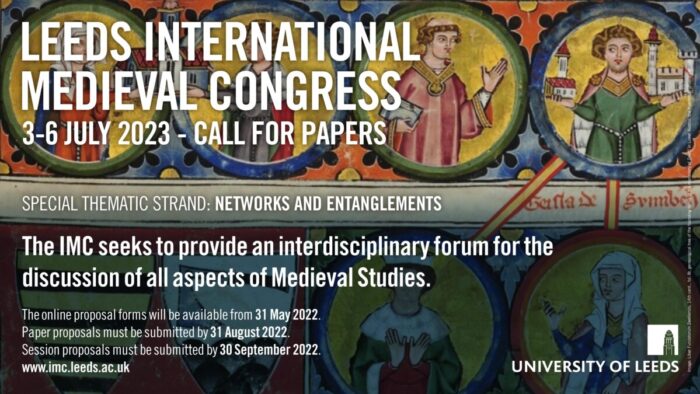
IMC 2023 took place from Monday 03 July to Thursday 06 July 2023 and it was our strong intention, coronavirus restrictions permitting, that there was both an in-person and virtual component.
Conference Programme
- Browse by timeslot
- Browse by sessions
- Browse by keywords
- Browse by strands
- Browse by sponsors
- Browse by participants
You can also download the archived PDF programme for IMC 2023 here, or download the IMC 2023 programme in large print here.
Call for Papers: IMC 2023 - Networks & Entanglements
The IMC provides an interdisciplinary forum for the discussion of all aspects of Medieval Studies. Proposals on any topic related to the Middle Ages are welcome, while every year the IMC also chooses a special thematic focus. In 2023 this is ‘Networks and Entanglements’.
‘Networks’ have become a much-employed term in the connected world of the 21st century, and also in scholarship. Historical studies, including medieval studies, have adapted concepts from sociology and digital tools to survey, visualise, and analyse the webs of interaction and relations among individuals, groups, places, artefacts, or polities. These notions emerge from a far-reaching relational approach across disciplines. Networks thus emerge from, or are defined as, multifaceted interdependencies. They highlight linkages between the human and non-human sphere, akin to how medieval people perceived manifold connections between the macro- and the microcosm. ‘Networks’ can address all kinds of relationships, connections, and correlations, their manifestations and structures, dynamics, and limits.
‘Entanglements’ is a term originally employed in studies of materiality to capture mutual dependencies between humans, artefacts, and sites in a fuzzier, but more flexible way. It has a key role in understanding complex connections, correlations, and relationships of diverse groups and cultures. Along similar lines, we invite medievalists of all fields to reflect upon linkages between individuals, groups, communities, and other bodies in various social and intellectual contexts, between humans, localities, and objects, between various species and ecologies, between motifs and iconographies, or between religious ideas, philosophical concepts, and narratives as networks of knowledge production. Especially welcome are attempts to entangle these various spheres, linking disciplines and methods, be they qualitative or quantitative, digital, or non-digital, or coming from archaeology, art history, linguistics, philology, history, or environmental, intellectual, literary, and religious studies.
Themes to be addressed may include, but are not limited to:
- Social, economic, or political networks within and between medieval societies
- Intellectual communities and networks of knowledge
- Religious networks and formations
- Spatial networks, architectures, and infrastructures
- Ecologies of connected, related, and entangled species
- Entanglements through artefacts and communities of practice and consumption
- Artistic networks and entangled iconographies and soundscapes
- Medieval and modern concepts of connectivity and interdependency
- Medieval and modern visualisations of entanglements and networks
- Medieval practices of networking
- Transnational, transregional, and trans-border networks
- Entanglements between the global and the local
- Narrative networks, literary and imagined entanglements
- Networks, mobilities, circulations, and flows, both real and fictitious
- Gendered networks: interconnections, relationships, and entanglements
- Network constraints, rules, and social roles
- Inclusion and exclusion through networks
- Identities, ego-networks, and emotional communities
- Network theory and complexity in medieval studies
- Digital humanities, linked data, and data ontologies
- Networks and networking in medieval scholarship past and present
- Ranges, limits, stability, and fragility of networks
The IMC welcomes session and paper proposals submitted in all major languages.
The Special Thematic Strand ‘Networks and Entanglements’ was co-ordinated by Johannes Preiser-Kapeller (Institut für Mittelalterforschung, Österreichische Akademie der Wissenschaften, Wien).
IMC 2022 PDF Programme
The IMC Programme Book contains details of all academic sessions, the Bookfair, as well as all events, excursions, workshops, and other IMC activities alongside essential information about attending IMC 2022 both online and in-person.
View and download the IMC 2022 Programme (pdf), File DownloadAccessible Programme
Please get in touch by emailing [email protected] if you have any queries, or would like to request an accessible version of the IMC 2022 Programme in an alternative format.
Physical IMC 2022 Programme Books
Physical copies of the IMC Programme Book will be available to all registered in-person attendees on arrival at the IMC. Owing to COVID-19 restrictions, alongside the changing ways in which delegates access information about the IMC, we will not be undertaking a mailout of the physical programme book as was the norm prior to the pandemic.
Details of how to collect your copy will be made available here in due course.
This PDF edition of the IMC 2022 Programme was last updated on 25 May 2022, 10:49. If you see an older version, you will need to clear your cache by holding down Ctrl+Shift+R (Cmd+Shift+R on Macs) after clicking through to the PDF viewer above.
Any additional papers, withdrawals, changes, or amendments received after this point will be reflected on Pathable, our virtual event platform, the IMC 2022 app, and via on-campus screens in Parkinson Court and the Refectory Foyer. Access to these will be provided to registered delegates during late June 2022.
IMC 2022
About IMC 2022
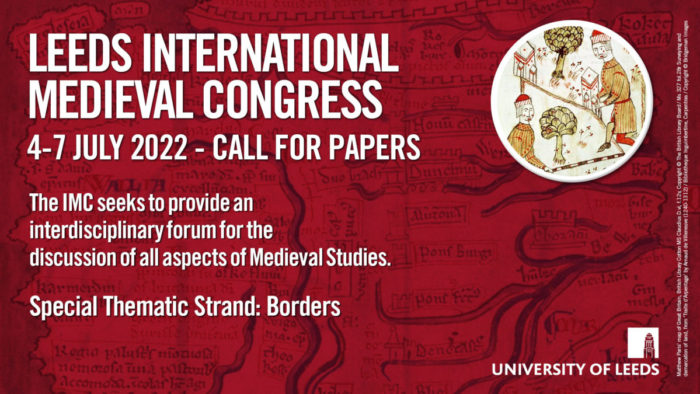
IMC 2022 was the first fully hybrid International Medieval Congress. Following the cancellation of IMC 2020, the Special Thematic Focus was 'Borders'. It was held between Monday 4 - Thursday 7 July 2022 both in-person here in Leeds and virtually.
Conference Programme
- Browse by timeslot
- Browse by sessions
- Browse by keywords
- Browse by strands
- Browse by sponsors
- Browse by participants
You can also download the archived PDF programme for IMC 2022 here.
Call for Papers
The IMC provides an interdisciplinary forum for the discussion of all aspects of Medieval Studies. Proposals on any topic related to the Middle Ages are welcome, while every year the IMC also chooses a special thematic focus. In 2022 this was ‘Borders’.
Medieval borders have preoccupied scholars for several decades in various guises. The term ‘border’ designates a wide variety of phenomena: physical geographical limits, that can be signalled by border markers or natural features, points where toll has to be paid, political boundaries, that vary from points in space to linear and fortified military fronts, ways of controlling space, frontier zones, borderlands, porous zones of encounters and contact, ways of limiting community and identity, ideological and metaphorical delimitation including discourse and representation, bordering practices, the process of creating and performing borders, and borderscapes to capture fluidity and change over time.
This strand seeks to bring together medievalists of all fields interested in both the theory and practice of borders in all their variety, from physical boundaries and material borders to dynamic social and spatial relationships. Borders can be linked to power and the formation of states, to definitions of self and other, to violence and military engagement, to belonging and becoming, to material and symbolic construction, to relational and perspectival production of space, to mapping and discourse, to experience and theory, to negotiation and performance. Borders can also be found in frescoes, textiles, clothing, ceramics or coins, with practical, symbolic or aesthetic functions. Borders are also subject to evolution and significant change over time not just between the medieval and modern, but within the medieval period.
Themes to be addressed may include, but are not limited to:
- Political and military borders
- Living in border zones
- Medieval and Modern perceptions, descriptions, and conceptualizations of borders
- Delimiting borders, border markers
- Border maintenance
- Encountering and experiencing borders
- Bordering practices
- Borderscapes in the longue durée
- Symbolic borders
- Belonging and exclusion
- Mapping borders and border zones
- Border institutions
- Materiality of borders
- Border and power
- Migration
- Medieval imagery of borders
- Transnationalism
- Political, social, cultural, religious performance of borders
- Village and parish boundaries
- Boundaries between town and countryside and within towns
- Practices of delimitation
- Blurring boundaries such as human/animal, animate/inanimate, gender, age, status, religion
- Self and other, boundaries of the self
- Fluidity and fixity of borders
- Borders in manuscripts
- Material and visual borders
- Processual and performative turns and medieval borders
- Disciplinary boundaries
- Paratexts as borders
- Borders of the body
- Transcending and reaffirming boundaries between life and death
- Borders, boundaries, frontiers
The IMC welcomes session and paper proposals submitted in all major languages, as well as virtual, hybrid, and in-person sessions.
The Special Thematic Strand ‘Borders' was co-ordinated by Nora Berend (Faculty of History / St Catherine’s College, University of Cambridge).
IMC 2021
 IMC 2021 was hosted online via the virtual events platform, Pathable, which can be accessed from any modern web browser from a desktop/laptop computer. Once logged in, delegates were able to access all aspects of the IMC, including academic sessions, Bookfair and other exhibitions, events and workshop programme, and social and networking opportunities.
- Browse by timeslot
- Browse by sessions
- Browse by keywords
- Browse by strands
- Browse by sponsors
- Browse by participants
The IMC provides an interdisciplinary forum for the discussion of all aspects of Medieval Studies. Proposals on any topic related to the Middle Ages are welcome, while every year the IMC also chooses a special thematic focus. In 2021 this was ‘Climates’.
Climates are engendered by powerful interactions of heavens, oceans, and earth, and are themselves potent forces in complicated relationships with water, landscapes, patterns of weather, and human and non-human life. They affect, and are affected by, other climates – including of thought, opinion, feeling, belief, politics, society, and economics. Medievalists study populations across the globe that understood this interconnectedness in multiple ways, invested causal and explanatory power in observable phenomena, and lived in communities that were both vulnerable and responsive to shifting environmental conditions. Climates – in the many senses of the word – are now among the most pressing issues of our times. Expertise on the medieval period is becoming increasingly important to scientific and public conversations, while intensifying global instability threatens both the future study of a period long synonymous with irrelevancy, and the preservation of its material remains.
‘Climates’ can be explored on many levels, from the planetary to the intimately local, offering alternative routes to explore ideas of centres and peripheries, agency and determinism, connectivities, interdependencies and comparisons, as well as what constitutes the ‘global’ in this period. It was within dynamic environments and ecosystems that humans lived, moved, organised themselves, developed cosmologies, philosophies, and theologies, created material objects, literatures, and other records, extracted and exchanged the resources of different regions, competed for land and power, and faced disaster, displacement, and violence.
Themes to be addressed may include, but are not limited to:
- Medieval concepts of ‘climes’ and ‘climate’
- Cosmologies, world views, natural or supernatural causation
- Medieval enquiry into weather, seasons, monsoon patterns
- Astronomical and astrological observations and predictions
- Agriculture, pastoralism, modification of landscapes, exploitation of resources, inequality, colonialism
- Environmental determinism, medieval histories of modern inequalities
- Societal organisation, hierarchy, law-making, governance
- Applying paradigms of adaption, resilience, and collapse
- Ecosystems, entanglements, human and non-human agency
- ‘Climates’ of opinion, thought, feeling
- Disease, pathogens, and microbes
- Relationships between climate change and human history
- Ecocriticism, critical race theory, indigenous knowledge, ecofeminism, queer ecology
- Weather and weathering
- Interdisciplinarity and integration of historical climate and environmental data
- ‘Provincialising Europe’: Writing history on the ‘planetary’ or biospheric scale
- ’Climates’ and interregional connectivities, interdependencies and disconnections
- Fluctuations in migration, mobility, trade, exchange, and transmission
- Seas, oceans, rivers, monsoon, floods as dynamic spaces
- Medievalists, politics, climate justice, pedagogy, and activism
- Preservation of material remains amid growing climate and societal instability
The Special Thematic Strand ‘Climates‘ was co-ordinated by Amanda Power (Faculty of History / St Catherine’s College, University of Oxford).
IMC 2020
Coronavirus (COVID-19)
It is with great sadness that we have decided to cancel this year’s International Medieval Congress, 6-9 July 2020, as a result of the outbreak of coronavirus (COVID-19). Read our full statement.
The programme below is correct as of Friday 20 March, 17:00 GMT
IMC 2019
Special Thematic Strand: ‘Materialities’, 1 - 4 July 2019
Conference Programme
- Browse by timeslot
- Browse by sessions
- Browse by keywords
- Browse by strands
- Browse by sponsors
- Browse by participants
The IMC provides an interdisciplinary forum for the discussion of all aspects of Medieval Studies. Proposals on any topic related to the Middle Ages are welcome, while every year the IMC also chooses a special thematic focus. In 2019 this is 'Materialities'.
Recent attention to objects, artefacts, matter, and material culture has reshaped scholarship in many fields. This strand seeks to address the impact of this new interest in things, theories, and methods as they relate to an expansive understanding of ‘materiality’. The study of materiality brings together a host of scholarly and theoretical concerns and puts them into dialogue to understand how conceptions of matter, and matter itself, shaped the creation of the material world, regimes of labour and supply, connectivity, entanglements, trade networks, movements of things and people, concepts of agency and network theory, and constructed notions of the sublime, of replication, and of ‘reality’, as an abstract concept and category during the Middle Ages.
This strand seeks to bring into conversation recent work on materialities by art historians, archaeologists, paleographers, historians, economists, musicologists, liturgists, philosophers, philologists, and scholars of literature, critical theory, and religious studies, among other fields. Material objects and practices served as markers of cultural difference, but could also - simultaneously - become part of a shared culture of consumption, proximity suggesting gender and class affinities. Material dynamics were embedded in the making of objects, the trade in raw materials, and the roles of men and women in the fabrication of things spanning the luxurious to the mundane. Materialities shaped cultures of consumption, created regimes of circulation, and informed networks that defined both subjects and objects. Materialities encompass interactions between peoples both near and far and offer an analytical framework that suggests the unity of the medieval world across religious, ethnic, and spatial distances and differences.
Themes to be addressed may include, but are not limited to:
- Material culture and consumption
- Materiality and the archaeological record
- Agency of people and things
- Medieval ‘thing’ theory
- Material connections: regimes of circulation
- Materialism and the Middle Ages
- Labour and production of things
- The social life of things
- Fabrication: production of specific objects
- Replication and reproduction
- Materiality of coins, money, and circulation
- Manuscripts: material and making
- Material textual and writing cultures
- Soundscape: material and musical culture
- Light and form
- Representing the material
- Body and spirit: spirituality and the material
- Space and materialities
- Materials: mundane (e.g. wood, water, dust) and luxurious (e.g. gold, silver, gems)
- Intimacies of things
- Abundance and/or scarcity
- Imagined materials
- Material landscapes: urban, suburban, rural
- Loans, debts, credit
- Materialities of power/empire
- Race and subjectivity
- Transformations: recycling, reuse, destruction
- Material religions: beliefs and practices
- Materials and memory
- Materialities and/of conflict
- Gendered materialities
- Digital/virtual/material archives
- Conservation and preservation
- Text and/as object
The Special Thematic Strand 'Materialities' will be co-ordinated by Anne E. Lester (Department of History, Johns Hopkins University).
IMC Policy on Dignity and Mutual Respect, including Social Media Policy
To ensure that everyone can make the most of the academic, networking, and social opportunities that the IMC offers, the organisers expect all delegates, exhibitors and staff to adhere to our policy on dignity and mutual respect at all conference venues and conference-related social events, as well as online and in any form of social media.
IMC 2018
2-5 July 2018
Congress Programme 2018: Special Thematic Strand: 'Memory'

- Browse by timeslot
- Browse by sessions
- Browse by keywords
- Browse by strands
- Browse by sponsors
- Browse by participants
IMB Quiz
To celebrate the 50th anniversary of our fellow IMS publication, the International Medieval Bibliography, all Congress delegates are invited to enter an online quiz at www.imb2018quiz.com.
This quiz is co-sponsored by Brepols Publishers and the top prize is a trip to Bruges, Belgium.
The quiz closes on 27 June 2018 at 10.00 CET. Only registered delegates for the IMC 2018 are eligible to participate.
Call for Papers/Sessions - International Medieval Congress 2018
The IMC provides an interdisciplinary forum for the discussion of all aspects of Medieval Studies. Paper and session proposals on any topic related to the Middle Ages are welcome, while every year the IMC also chooses a special thematic focus. In 2018 - the year of the 25th IMC - this is ‘Memory’.
There are many kinds of memory - personal and social, natural and artificial, political and cultural. Along the lines of this general taxonomy, memory operates in many diverse modes: as a mechanism, process, instrument, and cognitive framework relating to, and concerning recreations of, the past - the social past, the institutional past as well as the past of an individual. Central in the process of storing, retrieving, and (re)constructing the past, memory is by no means a stable entity; it is always undergoing transformation.
In recent decades, memory has become a very fashionable research topic. In Medieval Studies, the concept of memory has been studied as permeating history, literature, language, religion, science, philosophy, and other fields. In addition to treating the processes of storing and retrieving information, the study of memory now naturally also encompasses personal and communal identity and self-fashioning, conceptualization of the world, perception of time and space, intellectual cognition and emotional reactions, established patterns and creativity, continuity and discontinuity, memorization and forgetting - to name but a few conceptual domains under scrutiny. This, however, also means that the study of memory has gradually become very complex and even somewhat elusive. In this sense, this special thematic strand offers a unique opportunity for a fresh and vigorous treatment of the field of memory in its astonishing breadth and variety.
The IMC welcomes proposals in all areas of memory. Themes to be addressed may include, but are not limited to:
- Personal memory, self-fashioning, and identity
- Social, political, and religious memory
- The art of memory, mnemonics
- Memory: orality and literacy
- Knowledge and education - and its dissemination
- Metaphors for memory
- The media, mechanisms, and methods of memory - visual, verbal, and material memory
- Memory and beauty: aesthetic relevance and impact of memorization and remembering
- Objects of memory
- Lieux de memoire - communities and identity
- Construction and reconstruction of the past
- Memory: order and disorder
- Memory: sense and sensibility
- Commemoration and re-enactment
- Memory and immortality
- The arcane and daily life
- Memory and virtue
- Performance/drama/music - memory and playfulness
- Memory: habit and improvisation
- Forgetting and oblivion: natural processes vs. damnatio memoriae
- Forbidden memory
- Manipulative memory
- Categorization in language (analogy vs. anomaly, etc.)
- Etymologizing (including folk etymology)
- Formulas and catalogues
- Remembering the Middle Ages
The Special Thematic Strand 'Memory' is co-ordinated by will Lucie Doležalová (Institute of Greek & Latin Studies, Univerzita Karlova, Praha) and Jan Cermák (Department of English, Univerzita Karlova, Praha).
IMC Policy on Dignity and Mutual Respect, including Social Media Policy
To ensure that everyone can make the most of the academic, networking, and social opportunities that the IMC offers, the organisers expect all delegates, exhibitors and staff to adhere to our policy on dignity and mutual respect at all conference venues and conference-related social events, as well as online and in any form of social media.